2026-8-11 13:30 |
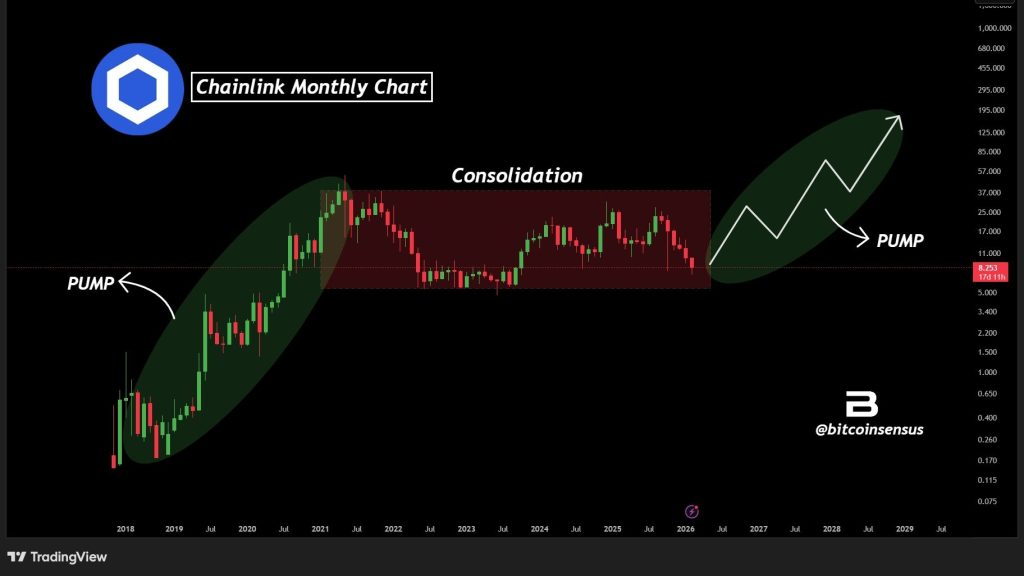
Let me tell you about a question this site has been asking all summer, coin after coin. We asked it of Uniswap, the toll booth on DeFi’s highway: does the toll ever reach the people who own the booth? We asked it of Arbitrum, the highway itself, where billions in traffic flow across a road whose token cannot seem to collect a cent. Every time, the answer was some version of “not really,” and every time the chart agreed. Then there is Chainlink. Chainlink answered the question. It built a mechanism that routes real fees into real buying of its own token, publishes the receipts monthly, and has been quietly accumulating for months. And the market’s response has been to price LINK about 84% below its all-time high. This page is about that gap.
LINK trades at $8.51 as of August 11, 2026, up 3.7% over 24 hours, per CoinGecko. It sits on CoinGecko’s trending and most-viewed lists simultaneously, the only infrastructure token to manage both today.
The Unique Angle: the receipt nobody readsHere is the mechanism, and it is genuinely unusual.
Most oracle and infrastructure tokens have the same design flaw: the network gets used, somebody pays for it, and the token holder watches from the sidewalk. Chainlink built around that with something called payment abstraction. Institutions using its services can pay in whatever they already hold, stablecoins, ETH, whatever suits their treasury, and the Chainlink Reserve converts those fees into LINK on the back end. The customer never has to touch a volatile asset. The token still captures the value. That is the loop that Uniswap has debated for years and Arbitrum has never closed.
And it is not theoretical. The Reserve publishes its own dashboard at reserve.chain.link, where the balance updates on-chain rather than in a press release. July added roughly 707,000 LINK, taking total holdings to about 5.21 million LINK, with the next update due in early September. Fees go in one side, LINK comes out the other, and anyone can check the ledger without asking permission.
So why is the token still near the bottom of its multi-year range?
Because the arithmetic, once you actually do it, is more modest than the story. Take July’s pace, roughly 707,000 LINK a month at today’s price, and you get something near $6 million a month, call it $72 million a year of protocol-funded buying. Now set that against a market capitalization in the region of $6 billion. The Reserve is buying on the order of 1.2% of the token’s market cap per year.
That number deserves to be said out loud because both sides of the LINK argument keep avoiding it. Bulls describe the Reserve as if it were a black hole absorbing supply. Bears ignore it entirely. The truth is duller and more useful: 1.2% a year is a real, persistent, non-speculative bid that did not exist two years ago, and it is nowhere near large enough to reprice a six-billion-dollar asset on its own. It is a floor mechanism, not a rocket. What would change that is the pace, and the pace is published monthly, which means anyone can check whether this thesis is strengthening or stalling without asking permission.
The One Number That Matters1.2%. The Reserve’s annualized buying as a share of market cap, based on July’s accumulation.
Watch this figure on this page every month, because it converts the entire Chainlink debate into something measurable. If institutional CCIP volume grows and the monthly accumulation doubles or triples, the ratio climbs toward levels where it genuinely constrains supply and the value-capture story stops being a promise. If July was a peak and the pace fades, the Reserve becomes a nice press release attached to a token that still cannot convert usage into price. Either way you find out from public data rather than from a narrative.
The Other Supply Story: stakingThere is a second mechanism worth understanding, and it works in the same direction.
Chainlink’s community staking pool holds roughly 45 million LINK, around 8% of circulating supply, and it has been at capacity for a long time with rewards in the mid single digits annually. Pool size, capacity status and the current reward rate are published on Chainlink’s own staking page, which is the only figure worth quoting since third-party trackers lag it. Staked LINK cannot be freely sold, so it functions as supply removed from the market. The roadmap targets a far larger pool, with figures around 200 million LINK discussed as staking expands to secure additional services like CCIP and Data Streams. If that expansion happens, roughly a fifth of circulating supply shifts from tradeable to locked.
The word doing the work in that paragraph is “if.” Roadmap targets are intentions, and this one has been discussed for a long time while the pool sat at capacity. Treat the 45 million as fact and the 200 million as a scenario to verify each month.
Now the Bear Case, ProperlyA page that only tells you about buying mechanisms is a brochure. Here is the other ledger.
Dilution is structural. LINK launched with a fixed one billion supply, of which something like 300 million was allocated to Chainlink Labs and 350 million to node operators and the ecosystem, against roughly 727 million circulating. How aggressively those reserves flow into the market is, in the words of analysts who cover the token institutionally, the primary tokenomics risk. A protocol buying $72 million a year of its own token means considerably less if the entity behind it distributes more than that from the other pocket. This one is checkable rather than debatable: the token contract and its largest holders sit in public view on Etherscan, and comparing treasury outflows against Reserve inflows is the single most useful hour anyone can spend on this token. It belongs in every serious LINK analysis, including the future updates of this page.
Usage and price have decoupled for years. The network is embedded almost everywhere: over a thousand data feeds, hundreds of integrations, adoption across major financial institutions, and recent integrations reaching into markets as large as reinsurance. And LINK trades around $8.51 against an all-time high near $52.88 from May 2021. Quarters often pass between an integration announcement and any measurable fee volume, and in speculative markets capital chases visible applications rather than the layer beneath them. Being indispensable and being well-valued are apparently unrelated conditions. The way to tell an announcement from an adoption is to watch fees rather than headlines, and DefiLlama publishes protocol fee and revenue tables across the market for exactly that comparison.
Product flows are soft. A US spot LINK exchange-traded product reported net assets in the tens of millions after the token fell sharply in the second quarter. That is a functioning wrapper without much money in it, which tells you where institutional enthusiasm currently sits.
Price Prediction ScenariosConditions, not conjured decimals.
Base case: the range persists. LINK chops between roughly $7 and $9 while the Reserve accumulates in the background and the market waits for a reason to care. Analyst consensus for August has clustered in this area, with some models putting the month’s likely floor near $8.11 and its ceiling near $9.83. Unexciting, and on current evidence the most probable outcome.
Bull case: the multiple catches up to the mechanism. The condition analysts have named is a sustained close above roughly $8.85, which is the first level that would signal the range breaking rather than flexing. If that coincides with genuine real-world-asset news flow and rising CCIP volume, targets in the low double digits come into the conversation, with some analysts framing a $12 to $15 zone as reachable in that scenario. State it plainly: that path requires fee volume to grow, not just integrations to be announced, and this is a scenario with conditions rather than a forecast.
Bear case: the floor fails. A break of $7 would be the first serious breach of a support zone that has held through a long decline, and it would put the multi-year lows back into discussion. The mechanism that makes LINK interesting does not prevent this; a 1.2% annual bid is not a defense against a market-wide risk-off move.
For long-horizon readers asking about the old high: returning to $52.88 implies roughly a 6x from here while absorbing whatever dilution the treasury allocations deliver. That is a full-cycle scenario contingent on the value-capture loop scaling by an order of magnitude, and it is speculation rather than a base case.
Key LevelsSupport: $8.11 as the near-term floor analysts have identified, then the round $8.00, then $7.00 as the structural line whose loss changes the story. Resistance: $8.85 as the level that opens the range, then $9.83, then the round $10.00 that has capped every recovery attempt this year.
Bottom LineChainlink is the rare infrastructure token that solved the problem this site keeps writing about: fees genuinely reach the holder, through a mechanism that publishes its own receipts. And it trades 84% below its high anyway, because the flow is currently 1.2% of market cap a year against a supply structure that includes large insider allocations and a market that has spent three years refusing to pay for plumbing. Both halves of that sentence are true, which is why this page will keep tracking one number rather than one narrative. If the Reserve’s pace accelerates, the mechanism starts to matter. If it does not, LINK remains indispensable, embedded, and cheap, which has been an accurate description for a very long time.
This article is for information only and is not investment advice. Crypto assets are extremely volatile and you can lose your entire stake. Always do your own research.
origin »Bitcoin price in Telegram @btc_price_every_hour
ChainLink (LINK) на Currencies.ru


|